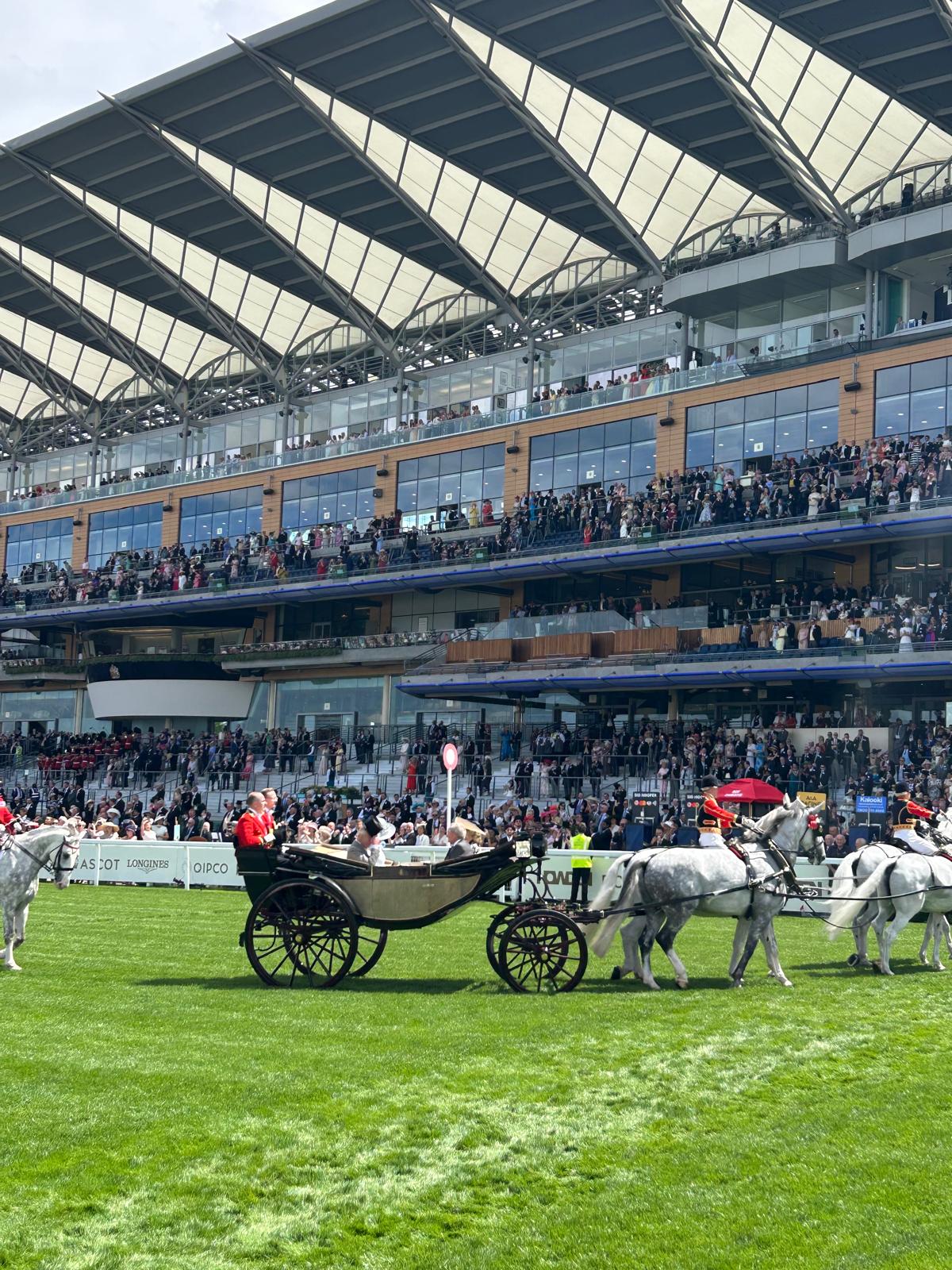
Royal Ascot 2026: Zac’s Triumph, a Historic Gold Cup, and an Ascot That Belongs to Everyone
Any South African racing fan at Royal Ascot would have felt the same sense of pride yesterday as I did, the feeling that arrives unannounced when racing gifts you a moment that feels both new and deeply familiar.
Because young Zac Lloyd didn’t just win yesterday; he stamped himself on the meeting with a ride that carried every echo of where he comes from.
And of course he would. He’s Jeff’s boy — Jeff Lloyd, our Jeff — the same man who gave me one of the greatest thrills of my racing life when he steered Diamond Quest to victory in the SA Gold Cup for me.
When Zac crossed the line, I felt that same old surge in the chest, the one only racing can give you.
- Rose Hall, writes about her thoughts on Royal Ascot as the SAHorseracing.COM representative on site.
A Ride Cut From His Father’s Cloth
Zac rode with that unmistakable Lloyd stillness — the quiet hands, the patience, the timing that seems almost supernatural.
You remember how Jeff used to sit chilly, wait, wait, wait, and then slip through a gap that only he could see?
Well, the boy has inherited that same magic.
For a moment, Ascot’s roar faded and I could almost smell the Durban July morning air — dust, polish, nerves, and the hum of expectation.
England’s grandest stage suddenly felt like home turf. Sadly, Greyville has not survived, but Ascot has flourished, and the Royal Meeting is now undoubtedly the best in the world. Zac has cemented his place here, and I am absolutely sure we will see a lot more of him at the Royal Meeting in the years ahead.
The Gold Cup: Race of the Week
This year’s 2026 Gold Cup was a clash of contrasts — youth versus experience, lightness versus grit — and it delivered a spectacle worthy of its crown-jewel status.
The race came down to two magnificent runners:
Scandinavia — the lightly raced four-year-old, partnered by the incomparable Ryan Moore and trained by the maestro Aidan O’Brien.
Trawlerman — the seasoned warrior, ridden by the ice-cool William Buick and trained by the English gent, John Gosden.
Scandinavia went into the race carrying one pound less and at half the age of Trawlerman — a fascinating dynamic that shaped the entire contest.
Trawlerman, last year’s winner, who spent Easter on life support, was brave as ever, battling his heart out and refusing to yield an inch. Incredible, given the horse very nearly died from a colic episode only months before.
But Scandinavia, with youth on his side and Moore’s trademark timing, found that extra gear in the final furlong.
It was the race of the week for me. I love a staying race anyway, but it featured my two favourite jockeys, and Trawlerman epitomises everything one would want in a staying horse. It was an incredible training feat to even get him to the race, and the fact he had no prep run was even more astounding.
It was a real gutsy performance by two equine and two human athletes, and it was sad that one had to come second.
Aidan O’Brien’s Historic Moment
Scandinavia’s victory marked Aidan O’Brien’s 100th Royal Ascot winner — a milestone that may never be matched.
It was also his 10th Gold Cup triumph, a staggering achievement.
Four of those, of course, belonged to the legendary Yeats, the iron horse who dominated the staying division like no other.
And here’s where the world folds in on itself again — because Diamond Quest, my own brave horse, ran in one of those Yeats Gold Cups.
It was, without a doubt, the highlight of my racing journey. We had flown him from South Africa to Dubai, where he won and was placed in five races, ridden in one of those by Ryan Moore, and then on to England, where he was trained by Andrew Balding.
Due to his Group 1 success in the Gold Cup in South Africa, we were then invited to the Melbourne Cup. I met with the Melbourne Cup handicappers at Ascot and was told he was almost certainly going to be bottom weight.
What a thrill that would have been, to have got there. But racing, as we all know, is not for those who can’t take disappointment. Very sadly, he niggled an old tendon injury in the race against Yeats, and I never got to experience what would have been the greatest thrill of my racing life: being an owner-breeder with a horse in the most historic and prestigious handicap of them all.
I was disappointed that Jeff Lloyd couldn’t come over from South Africa to ride him. Jeff knew exactly how Diamond Quest liked to be ridden — how to nurse him, when to ask, and when to wait.
But life and logistics got in the way, and he was ridden by Martin Dwyer, who didn’t know what Jeff knew, even though I had sent Andrew all the videos for him to watch.
Instead of waiting patiently at the back and then using my horse’s blistering turn of foot, he raced Yeats for most of the way round and was finished on the final bend, where he then felt his old injury.
Who knows what might have happened?
But Yeats was Yeats — a staying colossus who simply refused to be beaten.
Royal Ascot’s New Era: A Place for Everyone
But beyond the racing, something else struck me this year.
Royal Ascot has changed — and for the better.
The team behind the event have created a product that genuinely appeals to everyone: different enclosures, different price points, and only a small amount of that old stiff-upper-lip exclusivity.
I love it all and, as I’ve said time and time again in various racing publications, we have to encourage everyone.
I have had a total blast this year by venturing away from the Royal Enclosure and the Queen Anne Enclosure and into the midst of the Windsor Enclosure and the absolute party that takes place in the middle of the course in the Village Enclosure.
Every area has bands and masses of different places to eat, from Michelin-starred dining to street food. There are now lots of places to sit, plenty of shade, room to move around, and all different types of music performing between races.
It doesn’t detract from the racing at all. Instead, it adds to the atmosphere and gives younger generations what they want.
It’s a real opportunity for everyone to dress to the hilt and get the glad rags on.
Where else in the world, apart from the Melbourne Cup perhaps, equals that level of dressing up?
I’ve been horrified to see jeans and trainers at major race days in South Africa. I admit I got out of the heels after a few thousand steps, but no trainers are allowed anywhere at Ascot and certainly no jeans.
It’s fun to dress up, and there are fewer occasions to do so these days, so it’s a fabulous opportunity.
Royal Ascot also feels open now — welcoming, colourful and alive.
You’d be amazed at the mix of people. I was heartened to see far more people of colour than I have ever seen before.
It’s still Ascot, still elegant, still polished — but it’s no longer a place where only one type of person feels they belong.
It has become a celebration of racing and of people.
The Fireside Gathering Ladies
And speaking of people — I met the most delightful group of ladies.
Each from a different African nation, each with her own story, her own heritage and her own sparkle.
They had met on an online forum called Fireside Gathering, a space where women from across the continent share everything from racing tips to life advice and fashion debates.
They arrived at Ascot like a tapestry — colours, cultures, laughter and that unmistakable warmth you only get from African women who know how to make a stranger feel like family.
Seeing them there, owning the space with such joy, made me realise just how far this event has come.
A Win for Zac — and a Whisper of the Past
So yes, Royal Ascot 2026 will be remembered for its winners, its fashion and its theatre.
But for me, it will be remembered for:
A young man carrying his father’s legacy with grace. Jeff must be bursting with pride.
A Gold Cup that lived up to its legend.
Aidan O’Brien’s century of Ascot winners.
A racecourse that finally feels like it belongs to everyone.




.jpg)