For months, the narrative around Forever Young had been building toward something bigger than just another win. He wasn’t just dominating—he was threatening to redefine what a modern dirt champion could achieve on a global stage.
At Meydan Racecourse on Saturday night, that momentum met resistance. Real resistance.
Instead of a coronation, the $12 million Dubai World Cup became a test of limits—and it was Magnitude who exposed them.
The warning signs, in hindsight, were subtle but there. Forever Young had dazzled across continents, but Meydan had never truly been his stage. Even his UAE Derby win carried more grit than brilliance, and his third-place finish in last year’s World Cup hinted that this surface, this rhythm, might not bring out his absolute best.
On this night, those small doubts grew into something tangible.
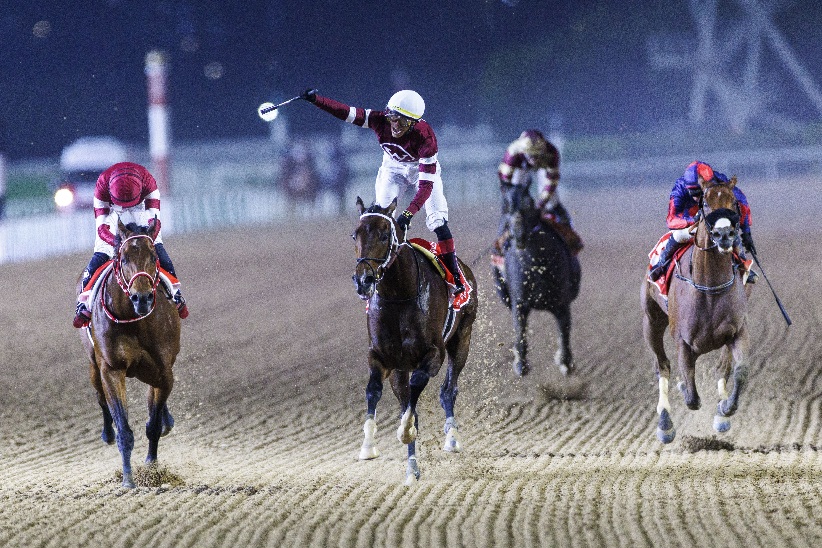
Magnitude, under Jose Ortiz, didn’t just win the race—he controlled it. Breaking sharply from gate one, he dictated terms from the outset, forcing Forever Young and Ryusei Sakai into a chasing role that never looked comfortable.
There was no panic from the favorite, just a quiet sense that he was being stretched in a way he hadn’t been before.
Turning for home, the race pivoted decisively. Magnitude quickened with authority, opening up daylight in a matter of strides. Forever Young responded, but not instantly—and at this level, hesitation is everything.
By the time he found top gear, the race was already slipping away.
He closed late, as elite horses do, but the margin—less than a length—felt more convincing than it looked on paper. Magnitude had already done the damage when it mattered most.
Trainer Yoshito Yahagi didn’t hide from the obvious afterward.
“Meydan doesn’t seem to suit him.”
It’s a simple explanation, but one that carries weight. Some horses travel the world and adapt seamlessly; others, no matter how brilliant, have tracks that dull their edge just enough to make them vulnerable.
Forever Young may have found his.
For trainer Steve Asmussen, the race was less about exposing a rival and more about trusting his own horse’s rhythm.
“We just wanted him to run his race,” he said.
That clarity showed. Magnitude wasn’t reacting—he was imposing. And in a race often defined by pressure and expectation, that freedom made all the difference.
There’s a tendency in racing to frame results like this as upsets, but this felt more like a correction. Forever Young didn’t run poorly—far from it. He was beaten by a horse who was sharper on the night, better suited to the conditions, and tactically in control from the break.
Even Jose Ortiz acknowledged the hierarchy heading in.
“We knew Forever Young is the best horse in the world,” he said.
On this night, though, the best horse in the world wasn’t the best horse in the race.
And maybe that’s the takeaway.
Not that Forever Young has been diminished, but that greatness in this sport is rarely absolute. It shifts with surfaces, with pace, with the fine margins that separate control from pursuit.
The Dubai World Cup didn’t crown a new king. It simply reminded everyone how hard it is to stay one.
Full Result — Dubai World Cup (G1, $12,000,000)
1st – Magnitude (USA)
2nd – Forever Young (JPN) – 0.98L
3rd – Meydaan (IRE) – 3.97L
4th – Imperial Emperor (IRE) – 4.08L
5th – Hit Show (USA) – 7.36L
6th – Tumbarumba (USA) – 7.76L
7th – Heart Of Honor (GB) – 16.15L
8th – Tap Leader (USA) – 25.00L
9th – Walk Of Stars (GB) – 37.82L
Image DRC
|


.jpg)




.jpg)
.jpg)