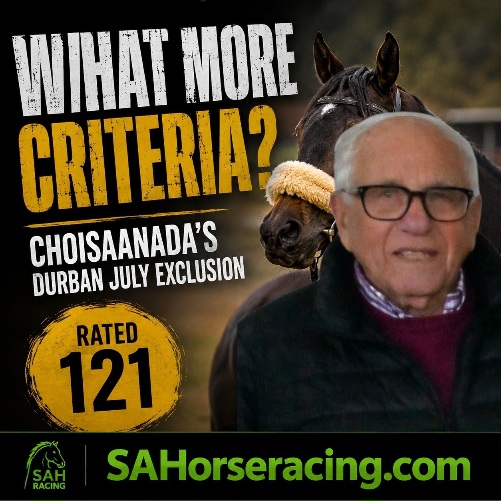
Few races carry the significance of the Durban July, and for owner Brian Jossel, the announcement of the final field delivered a blow he never saw coming. After more than five decades in racing, he believed Choisaanada had earned his place among the country's elite. Instead, the horse was left on the outside looking in, despite carrying a rating of 121 and having form lines that compared favorably with a number of runners who secured positions in the race.
The decision has sparked considerable debate within racing circles, but for Jossel the issue is a simple one. He cannot understand how a horse with Choisaanada’s credentials failed to make the final field.
“We were quite assured that we had our ticket for the Durban July,” Jossel who turned 90, four months ago spoke exclusively to SAHorseracing.COM. “There was just one question in our minds, the horses that we had already beaten that were going to be in. We never expected it to happen.”
The confidence of Choisaanada’s connections was not based on hope alone. Throughout the season, the gelding established himself as a high-class performer, earning a rating that placed him among the leading horses in the country. From Jossel’s perspective, the horse’s achievements on the track had already made the case.
His comments also reflected the emotional investment that goes into campaigning a horse capable of competing at the highest level. Jossel has owned horses for decades and has experienced the highs and lows that come with the sport, but he described Choisaanada as a horse who offered something out of the ordinary.
“I've been involved in racing for about 50 years,” he said. “I've had many, many horses and had great fun in racing.”
That long association with the sport has given him perspective, but it has also reinforced how rare opportunities such as this can be. Jossel spoke of the excitement generated by a horse who had consistently measured up against strong opposition and who appeared capable of taking his place in South Africa’s premier handicap.
“This is a peculiar situation because as an owner we don't own many horses but there's something special about being able to have a runner in the Durban July,” he said. “This was a chance of a lifetime.”
Central to his argument is the belief that Choisaanada possessed qualities that made him a legitimate contender for the race itself. Jossel highlighted the horse’s versatility, noting that few runners are capable of competing effectively across such a broad range of distances.
“Very few horses could run from 1400 metres, 1600 metres and 1800 metres at a high level and win. To be able to do that is remarkable,” he said.
That versatility, combined with the horse’s official rating and proven form, had left connections believing there was little danger of missing out. The final field announcement therefore came as a shock.
Jossel was careful in discussing those responsible for selecting the field. While he made it clear that he strongly disagreed with the outcome, he stopped short of making direct accusations. Instead, he questioned the reasoning behind the decision and suggested that greater transparency would help restore confidence in the process.
“I've got no idea how the minds of those people who voted against us worked,” he said. “Whatever happened, they will say they had their reasons.”
The veteran owner acknowledged that the panel would have its own justification for the final composition of the field, but he remains unconvinced that Choisaanada’s exclusion can be explained by racecourse merit alone.
“We feel we've been done down,” he said.
The disappointment extends beyond owner and horse. Jossel repeatedly returned to the people behind the scenes who invested their time, effort and belief into the campaign. In particular, he expressed sympathy for trainer Erico Verdonese and the stable team who had worked to bring Choisaanada to this point.
“I feel sorry for my trainer,” Jossel said. “I feel for them all.”
He also reflected on the wider impact of the decision, noting that everyone connected to the horse had shared the dream of competing on the country's biggest racing stage.
“It's not a very nice thing to happen,” he said.
Despite his frustration, Jossel made a point of separating his disappointment from the fortunes of those who did make the race. Significantly, he said he harbored no resentment toward rival owners or connections and hoped the Durban July would be a success for everyone involved.
“I hope and pray that none of the horses get injured,” he said. “I hope the owners have wonderful joy and the trainers and jockeys enjoy the race and possibly find a winner.”
Those comments underscore the sporting perspective Jossel has developed over half a century in racing. Even while questioning the decision, he emphasized that the focus should remain on the horses and the people who dedicate their lives to the sport.
At the same time, he believes there are legitimate questions that deserve examination. While acknowledging that any review is unlikely to alter the outcome, he said the circumstances surrounding the selection process warrant closer scrutiny.
“I hope there's an inquiry into what happened” he said. “Not that it's going to help very much, but I do feel there are questions that need answering.”
The final field has been declared and the Durban July will proceed without Choisaanada, who is a reserve runner. Nothing can change that reality now. Yet as anticipation builds toward race day, discussion surrounding the gelding's exclusion continues to gather momentum.
For Jossel, the disappointment is not simply about missing a race. It is about a horse he believes earned his opportunity, a team whose dream was denied, and a selection outcome he still cannot reconcile with the evidence presented on the track.
More than anything, one question continues to linger.
“What more criteria?”
|