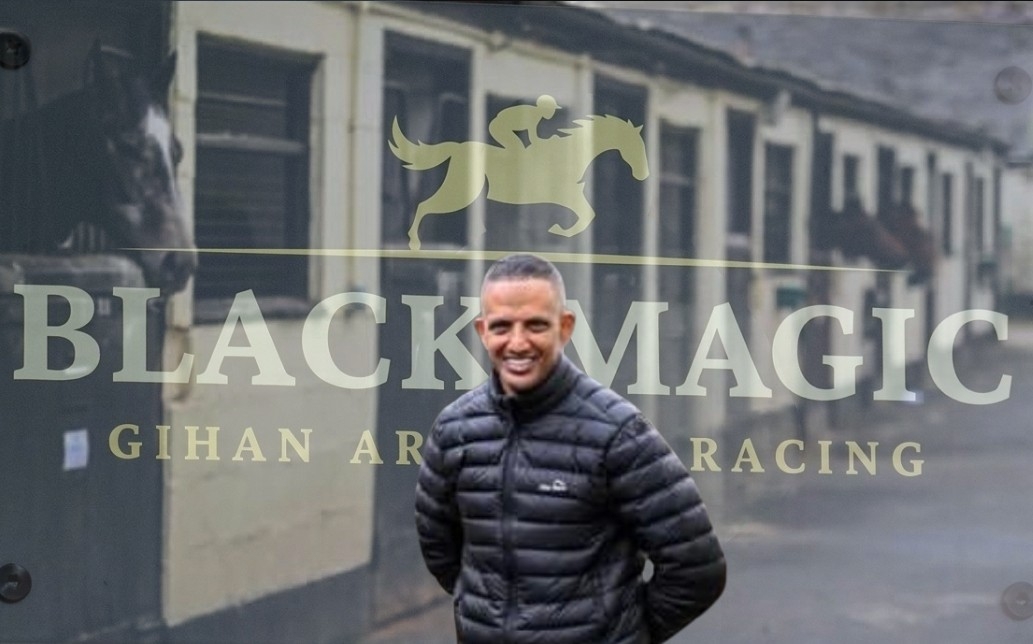
When Gihan Arnolda sends out his first runners this week, the milestone extends beyond typical debut-season nerves. The 16-horse Newmarket operation represents the training center's first license held by someone of Black or Asian heritage, a demographic gap that persisted unnoticed until Arnolda's application process made it impossible to ignore. His route to that distinction passed through East London homelessness, a career-ending race riding injury, and 15 years of assistant work that built both expertise and credibility. The yard's opening runners arrive with modest expectations but significant symbolic weight in a sport still mapping its approach to representation beyond the weighing room. SAHorseracing.COM caught up with Arnolda about his new career.
From Apprentice to Assistant
Arnolda describes his origins without embellishment. "I started off in the East End of London, which can be some parts of quite a deprived area," he explains. "My mother and father are Sri Lankan and Portuguese extract, so we have Asian and black through my heritage. Tough upbringing. Things didn't end up very good, and I ended up going into the foster care system." After homelessness between ages 12 and 14, placement with a white English foster family provided the stability that allowed him to excel academically. He enrolled in law college before abandoning that trajectory for the apprentice school. He rode between 200 and 300 races with a handful of winners before a fractured pelvis at Yarmouth in 2009 ended his riding career at its earliest stage. "I had a bad injury, broke my pelvis at the racecourse at Yarmouth, and gave up in 2009," Arnolda recalls. The transition from jockey to trainer took 15 years of groundwork. Arnolda credits three trainers with shaping his development. "Chris Wall was unbelievable, how much I learned there," he says of his first major position. "Roger Varian, a gentleman, great trainer. And then on to Peter Chapple-Hyam, who also, yeah, I got a lot of knowledge from." His most recent position with small-scale trainer Denis Quinn produced 18 winners from 15 horses over 15 months, a strike rate that demonstrated readiness for independent operation.
Newmarket Establishment
Arnolda's training operation launched with backing from owner Chris Housego, who also campaigns horses with South African trainer Dylan Cunha. The connection proved instrumental in securing an initial roster. "Dylan's a gentleman and a very, very good trainer, doing ever so well," Arnolda notes. "I think he'll go to the very, very top in England." Another South African link came through jockey Kyle Strydom. "Kyle's ridden out for me before he went back home, and I understand he's doing well back in South Africa. Another gentleman of a guy." The yard currently houses 16 horses in training with two turned out, and Arnolda expects to add purchases from the July sales to reach approximately 20. The string includes three or four horses rated between 80 and 90, providing legitimate opportunity for open company success. First runners are scheduled across Thursday, Saturday and Sunday meetings. "I'd like to hit double figures this season because we've got quite a late start," Arnolda says of his target despite the condensed timeframe.
Representation Questions
Arnolda learned only recently that his license represents a demographic first for Newmarket. "I'm quite privileged," he reflects. "I'm probably the first actual Asian or Black ethnic backgrounds to get a training license in Newmarket, which is amazing. I didn't actually realize that. Someone pointed that out." The realization carries weight in a sport where diversity remains concentrated in riding ranks rather than training and ownership structures. His stated aim extends beyond personal achievement. "The main thing is I'd like to inspire people coming from different backgrounds, different starts in life where it's not so easy, and to try and get the opportunities if they can get them and work hard. You can do it," he explains. The message targets individuals from underprivileged backgrounds who might not see traditional access points into racing's professional tiers. The East End to Newmarket trajectory required navigation of foster care, academic redirection, career-ending injury and 15 years of assistant work. Arnolda's yard now joins Newmarket's training establishment with modest but credible resources and a defined goal of proving that alternative routes to the sport's upper levels can function when work ethic meets opportunity. Whether the operation scales beyond 20 horses will depend on early-season results and owner confidence, but the license itself marks a shift in Newmarket's demographic composition that the training center has not previously recorded.
|