Tokyo Racecourse stages the 21st running of the Victoria Mile on Sunday, the latest leg in Japan’s uninterrupted five-week sequence of Grade 1 racing. Run over 1,600 meters for fillies and mares aged four and older, the race has drawn 20 nominations for a maximum field of 18, with JPY150 million to the winner from a total purse of JPY326.5 million. The focus this year falls heavily on proven elite performers, headed by Embroidery, Kamunyak and last year’s narrow runner-up Queen’s Walk, in a race that traditionally rewards tactical positioning and acceleration through Tokyo’s demanding final straight.
The Tokyo mile remains one of the more exacting configurations in Japanese racing despite its reputation as a fair course in relation to barrier positions. The field begins on a downhill run before climbing sharply, then swings into a long straight that includes the track’s defining uphill section inside the final 400 meters. Horses able to sustain momentum rather than produce only a brief sprint often hold the advantage.
Recent editions of the Victoria Mile have generally favored the market leaders. The favorite has finished in the top three seven times in the past decade and won three of those renewals. Yet the race has still produced volatility, including last year’s shock result when Ten Happy Rose prevailed after entering off a modest sixth in the Hanshin Himba Stakes.
Embroidery Brings Proven Class
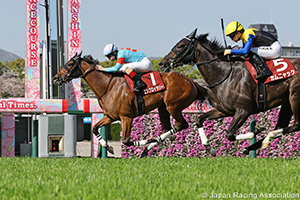
Embroidery (pictured) is likely to start favorite after establishing herself as one of the leading mares in training. The daughter of Admire Mars was crowned the JRA’s Best Three-Year-Old Filly of 2025 after victories in both the Grade 1 Oka Sho and Grade 1 Shuka Sho. Her record stands at six wins from 10 starts, including victories at Grade 2 and Grade 3 level.
The four-year-old also brings substantial experience at the distance. Six of her starts have come over 1,600 meters, including two at Tokyo, while her base at the nearby Miho training center adds another layer of familiarity. Following an unsuccessful attempt in the Grade 1 Hong Kong Mile in December, she resumed with victory in the Grade 2 Hanshin Himba Stakes on April 11.
Trainer Kazutomo Mori acknowledged the relatively short turnaround between runs but indicated confidence in her condition heading into Sunday.
“It would be ideal if she had a bit more time between races, but I’ll have her largely back to the same condition as she was for the Hanshin Himba Stakes,” Mori said.
Christophe Lemaire is expected to ride. A victory would give him a record-extending fifth success in the Victoria Mile after last year’s win aboard Ascoli Piceno.
Kamunyak Looks Dangerous Late
Kamunyak may still be searching for a first win at 1,600 meters, but her latest effort strongly suggested the distance is within range. The Japanese Oaks winner finished only a neck behind Embroidery in the Hanshin Himba Stakes and produced a joint-best final three-furlong split of 33.2 seconds.
Her overall profile remains strong. She has won four of eight starts, including the 2025 Japanese Oaks and two Grade 2 contests, and her closing speed shapes as a major weapon around Tokyo.
Trainer Yasuo Tomomichi believes the course layout should suit her running style.
“This race is also over 1,600 meters and it’s Tokyo with a nice, long stretch,” Tomomichi said. “If she can race like her most recent race, I think she’ll be able to draw on her late speed.”
Yuga Kawada is expected to partner the mare. A win would place him alongside Christophe Lemaire, Masayoshi Ebina and Yutaka Take as the only jockeys to have captured all six current Grade 1 races restricted to fillies and mares in Japan.
Queen’s Walk Returns After Near Miss
Queen’s Walk returns to the race after going down by a neck to Ascoli Piceno in last year’s edition, a performance complicated by interference in the straight. Although much of her best work has come over 2,000 meters, the Tokyo mile has historically suited horses with stamina beyond the specialist sprint-mile profile.
Her latest run came in the Grade 2 Kinko Sho at Chukyo in March, where she finished third behind two male runners, beaten only a half-length and a nose. Despite receiving a slight weight advantage from most of her rivals, the effort drew praise from Kawada.
“She gave it everything she had until the very end,” Kawada said. “It was definitely an all-out effort.”
Trainer Mitsumasa Nakauchida noted that the mare had returned from her break in stronger condition than she had at the same stage last season.
“After time at the farm, she came back to the training center on April 17 looking refreshed,” Nakauchida said, adding that she had adapted well to warmer conditions.
Cervinia Faces Familiar Company
Cervinia enters after a series of tough assignments against male opposition. Since winning both the Japanese Oaks and Shuka Sho in 2024, all seven of her subsequent starts have come in graded company against males, including three Grade 1 appearances and one overseas attempt.
Her latest effort produced a fifth-place finish in the Grade 2 Nakayama Kinen over 1,800 meters, where she closed strongly despite interference in the straight and finished only 0.4 seconds from the winner. Damian Lane is expected to take the ride as she returns to an all-female field for the first time since her classic campaign.
Lavanda And Coconuts Brown Offer Value Angles
Lavanda’s form around Tokyo makes her difficult to dismiss despite a below-par eighth in the Hanshin Himba Stakes. Earlier this year she split male rivals in the Grade 3 Tokyo Shimbun Hai over the same course and distance, finishing second behind Trovature in a tightly compressed field.
Her overall Tokyo record reads 2-11-3-1-2, and last season she was beaten only a double nose in a close finish. The significantly faster tempo in this year’s Hanshin Himba Stakes may help explain her latest defeat.
Coconuts Brown enters from a different profile altogether. The six-year-old has built her reputation steadily through middle-distance graded races, but trainer Hiroyuki Uemura believes the return to 1,600 meters may unlock improvement.
“At this distance she can ride the pace more comfortably and access more of her potential,” Uemura said. “If the race comes down to who has the best turn of foot over the long stretch, it should work in her favor.”
The daughter of Kitasan Black faces new variables, including her first Tokyo trip in several months and her first mile attempt in five starts.
Others In Contention
Jocelyn shortens to 1,600 meters for the first time after consistently competing between 1,800 and 2,000 meters. A full sister to three-time Grade 1 winner Efforia, she has yet to finish worse than fourth and returned from her Shuka Sho campaign with a Grade 3 success at Kokura earlier this year.
Paradis Reine also brings a notably consistent profile, with only three finishes outside the top three from 10 starts. Her Grade 1 formline of 4-3-2 commands respect, although Sunday will mark her first attempt below 1,800 meters.
Nishino Ti Amo arrives after overcoming throat surgery and reeling off four consecutive victories over 1,800 to 2,000 meters, including the Grade 3 Fukushima Kinen. Her return run in March suggested she remains competitive at this level.
With proven Grade 1 performers, established late closers and several mares attempting to stretch their tactical range, this year’s Victoria Mile shapes as another edition where positioning into Tokyo’s final climb may prove as decisive as outright class.
|